Internet Pioneers
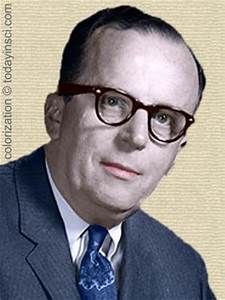
J.C.R. Licklider
In 1962, Dr. Joseph Carl Robnett Licklider formulated the earliest ideas of global networking discussing thenan “Intergalactic Computer Network.” He envisioned a globally interconnected set of computers through which everyone could quickly access data and programs from any site. In 1963, Dr. J.C.R. Licklider’s persuasive and detailed description of the challenges in establishing a time-sharing network of computers that ultimately led to the creation of the ARPAnet. His 1968, he illustrated his vision of network applications and predicted the use of computer networks for communications through a detailed paper called “The Computer as a Communication Device”. Until then, computers had generally been thought of as mathematical devices for speeding up computations.
Bob Kahn
In October 1972, Kahn organized a large and very successful demonstration of the ARPANET at the International Computer Communication Conference (ICCC). This was the first public demonstration of this new network technology to the public. It was also in 1972 that the application, electronic mail, was introduced. In March Ray Tomlinson at BBN wrote the basic email message send and read software, motivated by the need of the ARPANET developers for an easy coordination mechanism. In July, Roberts expanded its utility by writing the first email utility program to list, selectively read, file, forward, and respond to messages. From there email took off as the largest network application for over a decade. This was a harbinger of the kind of activity we see on the World Wide Web today, namely, the enormous growth of all kinds of “people-to-people” traffic.
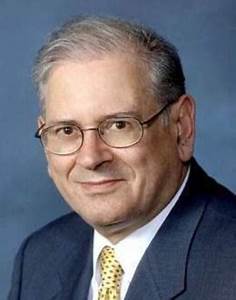
In the spring of 1973, Kahn approached Cerf with the idea of developing a system for interconnecting networks—what would eventually be called an “internet.” Kahn felt that his own knowledge of the problem of connecting dissimilar networks, combined with Cerf’s expertise in writing host software, would create a strong partnership. In addition, Kahn and Cerf demonstrated farsighted leadership by inviting networking experts from around the world to weigh in on the Internet design at a seminar in June 1973. This move not only led to more robust protocols, but also laid the groundwork for the global spread of the Internet.
Lawrence Robert
Dr. Robert designed and managed the first packet network, which was the ARPANET. In 1967, Dr. Roberts started the task of designing, funding, and managing the radically new communications network concept of packet switching. In April 1967,Roberts presented the technical specifications for the network in an ARPAnet meeting. However, after the meeting, computer scientist Wesley Clark suggested Robert that the actual networking should be handled by smaller computers called interface message processors (IMPs) rather than the large mainframes that would be the nodes of ARPANET. Roberts modified the ARPANET plan to incorporate Clark’s suggestion. On October 29, 1969, American computer scientist Leonard Kleinrock and his student Charley Kline sent the first message over ARPANET from an IMP and computer at the University of California, Los Angeles, to an IMP and computer at Stanford Research Institute in Menlo Park, California.
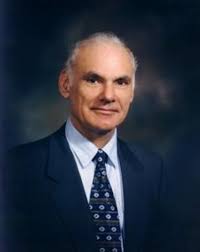
Computers were added quickly to the ARPANET during the following years, and work proceeded on completing a functionally complete Host-to-Host protocol and other network software. In December 1970 the Network Working Group working under S. Crocker finished the initial ARPANET Host-to-Host protocol, called the Network Control Protocol (NCP). As the ARPANET sites completed implementing NCP during the period 1971-1972, the network users finally could begin to develop applications. In 1971 Lawrence Robert wrote one of the first e-mail programs, RD, which for the first time allowed users to save, delete, and organize their messages.
Vint Cerf
Within a few years of the creation of the ARPANET, other computers networks were deployed. They were all independent self-contained networks. Around this time Bob was looking for a solution to connect and communicate computers at different places and on different networks. While looking for the solution they realized that there needed to be a "gateway" computer between each network to route packets. The gateway computers would not care about the various complexities of each network. They would simply be in charge of passing packets back and forth. But all of the networks transmitted packets in different ways, using their own protocols. So a new standard was needed to link all the networks and allow inter-network communication. Cerf and Kahn began working out a plan in 1973.
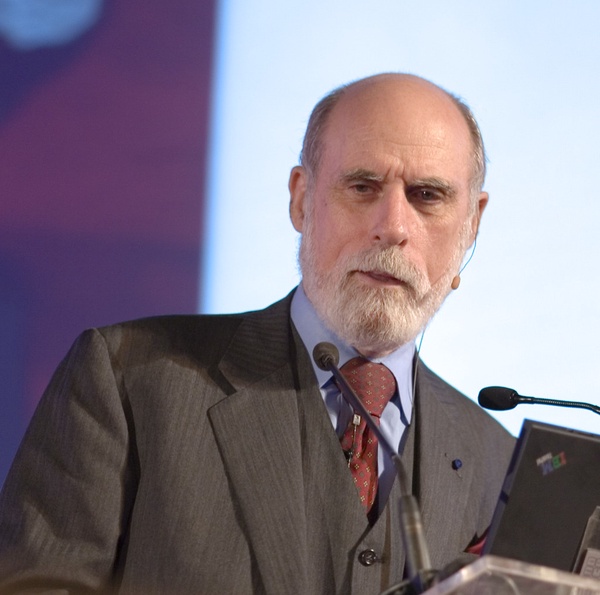
In September, they presented a paper outlining their ideas to the International Networking Group. In May 1974, they complete their paper, "A Protocol for Packet Network Intercommunication." They described a new protocol which is known as the transmission-control protocol (TCP). The main idea of this protocol was to enclose packets in "datagrams" that would act as the envelopes containing letters. The content and format of the letter is not important for its delivery. The information on the envelope is standardized to facilitate delivery. Gateway computers would simply read only the delivery information contained in the datagrams and deliver the contents to host computers. Only the host computers would actually "open" the envelope and read the actual contents of the packet. TCP allowed networks to be joined into a network of networks, or what we now call the Internet. Cerf continued to refine TCP. In 1978, Cerf and several of his colleagues made a major refinement and they split TCP into two parts. They took the part of TCP that is responsible for routing packages and formed a separate protocol called the Internet Protocol (IP).TCP would remain responsible for dividing messages into datagrams, reassembling messages, detecting errors, putting packets in the right order, and resending lost packets. The new protocol was called TCP/IP. It went on to become the standard for all Internet communication.
Tim Berners-Lee
Tim Berners-Lee invented the World Wide Web in 1989, but the use of the WWW became widespread in the mid 1990’s. Lee envisioned a global information space where information stored on computers everywhere was linked and available to anyone anywhere. In 1989, Lee submitted a proposal at CERN to develop an information system that would create a web of information. In 1990, he wrote the Hypertext Transfer Protocol (HTTP)—the language for computers to use to communicate hypertext documents over the Internet and designed a scheme to give documents addresses on the Internet which is known as Universal Resource Identifier (URL).